Why Travellers Kept Their Tickets
Why travellers kept their tickets: see how printed routes and admission details served as everyday records, and what their survival reveals about travel habits.
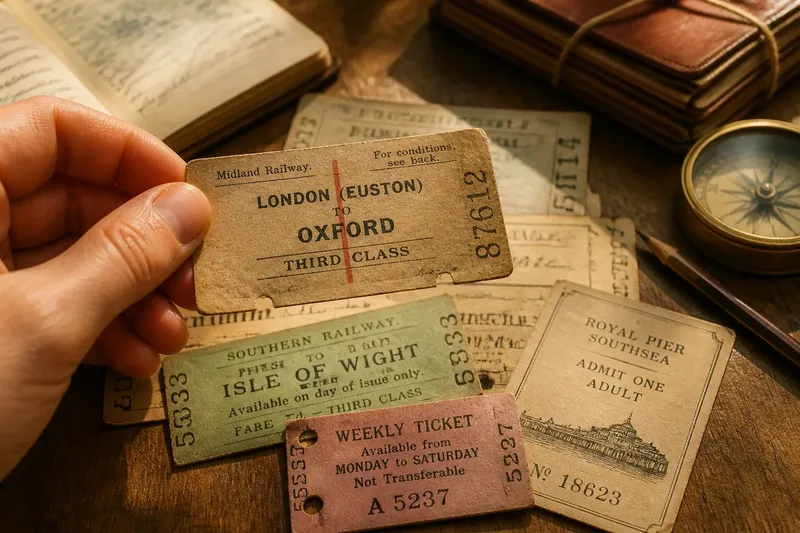
The common mistake with old travel tickets is to treat them as proof of a journey without asking what kind of record they were. A ticket was first a working document: it authorised a ride or entry, and its printed route, class or conditions helped staff and passengers manage the transaction. Its later life as a keepsake came after that practical job.
Why travellers kept their tickets as everyday records
For much of rail, ferry and public transport history, a ticket was a small, portable record of a particular passage. Its printed details could identify a route, destination, fare class or date, depending on the system and period. Retaining one might help a traveller recall the journey, but it could also be useful for sorting papers or accounting for travel expenses.
Tickets were not all alike. Some were collected or issued for a single ride; others covered a return journey, a season or admission to an event. Their format and information changed with the transport operator and the technology in use, so an old ticket should be read as evidence of its own system rather than as a universal account of how people travelled.
What a surviving ticket can and cannot tell you
A printed station, route or venue can establish a connection between places or an occasion of entry. A ticket may also carry clues in its design, wording or marks of use. Those details can help place it in context, but they do not explain why the trip mattered or who accompanied the traveller.
Keep the distinction clear between printed evidence and later recollection. If a date or destination is legible, record it as printed; if you infer a likely route from a station name, mark it as an inference. That small distinction prevents a family story from becoming more certain than the object supports.
Read the ticket as a travel object, not a complete story
A ticket belongs to the material side of travel: it was handled, carried, checked or surrendered, and some examples survived because someone set them aside. Creases, punched holes and faded ink can indicate use or storage, but they do not reveal a whole day’s events. Treat wear as a clue to ask about, not a scene you can reconstruct by itself.
Say you inherit a hypothetical railway ticket bearing the names of two stations, with no date and no family account. You first transcribe the legible wording, then compare the station names with a period timetable or map if one is available, and note that the route is only a possibility unless the ticket itself confirms it. The result is a grounded description—what the paper says, what it may suggest, and what remains unknown—rather than an invented travel narrative.
Use a careful process when identifying an old ticket
- Check whether the text is legible; if it is, transcribe it as printed, and if it is not, record the uncertain letters rather than guessing.
- Check for a printed date; if one appears, record it as ticket information, and if none appears, do not assign a date from appearance alone.
- Check the named stations or venue; if both are clear, describe the stated connection, and if only one is readable, keep the destination or route unresolved.
- Check for a fare class, return wording or validity condition; if present, include that wording, and if absent, avoid inferring the ticket’s terms.
- Check for handwriting or a stamp; if it adds a name or place, describe it separately from printed text, and if it is unclear, mark it as uncertain.
- Check whether the ticket is fragile or fading; if it is, handle it as little as possible and seek advice from a paper conservator for valuable or delicate material, while if it is stable, store it in a labelled paper sleeve.
How should you interpret and store an old travel ticket?
Does a ticket prove someone took a journey?
It can show that a ticket was issued for a stated route or event, but it may not prove that the named journey was completed. Describe what the object records, and avoid turning an issued ticket into proof of arrival.
Can you date a ticket from its appearance?
Appearance alone rarely supports a precise date. Use printed dates or other reliable context where available, and label any broader estimate as uncertain.
Should you write on an old ticket?
Avoid writing directly on fragile or historically significant paper. Put notes on a separate slip or sleeve so the original remains legible and unaltered.
What is a sensible way to store one?
Keep the ticket flat in a suitable paper enclosure, away from damp, direct sunlight and adhesive. If it is delicate, valuable or deteriorating, ask a paper conservator for handling and storage advice.
Preserve the useful record without overinterpreting it
Not every ticket needs elaborate research or a long family account. It is not worth trying to identify every faded mark or reconstruct a journey from a partial route when the evidence cannot support a confident answer. A clear transcription and a note about uncertainty are often enough.
Why travellers kept their tickets has no single answer: some retained practical records, while others saved a trace of a route or occasion. When you encounter one, begin with its printed purpose and visible clues, then leave personal meaning open unless another reliable source supplies it.