A Rainy Afternoon for Sorting Journey Fragments
Sort journey fragments into useful groups with a simple process, clear choices for uncertain papers, and a worked example that keeps memories honest.
The common mistake with journey fragments is sorting them by type before deciding what you want to keep. It can leave you with tidy stacks of tickets and receipts but no clear way back to the moments that matter. Sorting journey fragments works better when you make a simple decision about each piece: keep it for a memory, keep it for a practical reason, or let it go.
Set out a clear table, several envelopes or folded sheets of paper, and a pencil. Gather only the loose items you want to sort today. You do not need to identify every fragment or finish the collection in one sitting.
Sort journey fragments with a clear sequence
Use the same sequence for each paper: inspect it, recall what you can, choose a group, decide whether to keep the original, and store it. The steps below give uncertain items a place too, so you do not have to invent a story to complete the process.
- Check what the fragment is. Look for a place name, date, route, or other readable detail. If it identifies a practical record you may still need, set it aside for that purpose; otherwise, continue to the next step.
- Notice what you remember. Ask whether a particular scene, person, or feeling comes to mind. If a real memory appears, note its brief clue; if not, leave the clue blank rather than guessing.
- Choose a memory group. Put together fragments connected to the same scene, shared moment, or mood. If two papers do not feel connected, start separate groups instead of forcing a link.
- Keep separate journeys separate when needed. A similar feeling can connect fragments from different trips, but mark that group as a recurring mood rather than implying the papers came from one journey. If the distinction is unclear, keep the items in separate envelopes.
- Decide whether the original paper earns its place. Keep it if it carries a memory or practical information you want; if it contains sensitive details or serves no purpose, consider recording the memory separately and letting the paper go.
- Store the group so you can find it again. Put related papers in an envelope or folder and add a short label. If you cannot name the place or event confidently, use a neutral label such as “uncertain” rather than making one up.
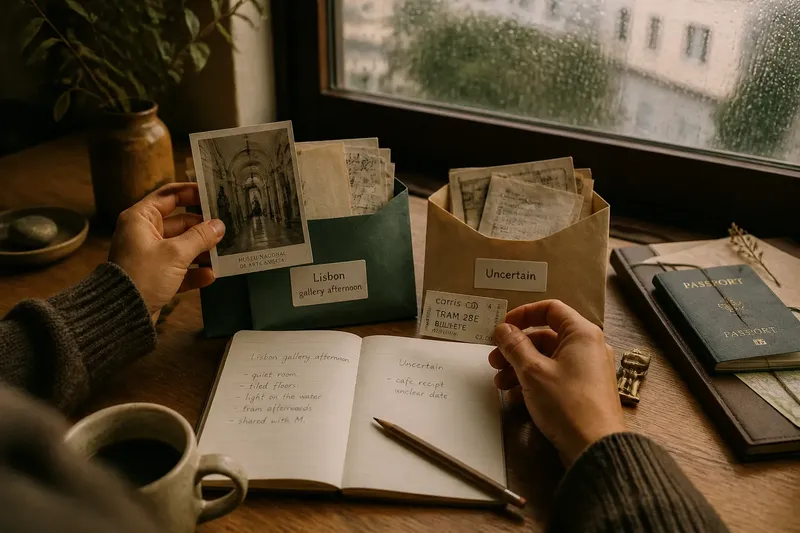
For a quick decision, imagine you find a folded gallery leaflet, a tram ticket and a café receipt in a travel drawer. The leaflet brings back a quiet room in Lisbon, the ticket recalls a crowded ride afterwards, and the receipt has no readable date or clear memory. You place the leaflet and ticket together only if that sequence feels connected, put the receipt in an envelope marked “uncertain”, and keep the group in a folder labelled “Lisbon gallery afternoon”. The result is one retrievable memory group and one unresolved paper, not a claim that every fragment belongs to the same event.
Use different groups for scenes, moods and shared memories
A scene-based group connects papers to one event: a museum handout and a ferry stub might both recall a particular afternoon. A mood-based group can connect different days or journeys, but label it as a recurring feeling, such as “unhurried mornings”, so the arrangement does not blur separate trips.
For a journey shared with someone else, ask what each person remembers before writing a caption. Keep distinct notes if your recollections differ; neither account needs to become the official version. If a memory feels private or the details are disputed, leave it out of a collection that other people will see.
Make a decision for every uncertain or sensitive paper
Use this quick check when a fragment does not have an obvious place. Each observation points to a practical choice, with an alternative if the first option does not fit.
- If a place name or date is readable and you recognise the journey, file it with that journey; if the connection is unclear, place it in an “uncertain” envelope.
- If the paper brings back a specific scene, group it with items from that scene; if no scene returns, keep it separate rather than inventing one.
- If the fragment recalls a mood shared across different trips, label the group as a recurring mood; if that label could confuse the journeys, use separate envelopes.
- If a companion recognises the same event, add their note beside yours; if your memories differ, keep two notes or leave the disputed detail unwritten.
- If the paper contains booking details, an address, or another personal detail you do not want others to see, remove it from a shared collection; if you still need the information, store it privately.
- If a paper may be needed for a booking, reimbursement, or personal record, check the relevant document guidance before discarding it; if the consequences are legal or financial, ask a qualified professional.
- If the fragment has no memory and no practical use, consider letting it go; if you are unsure, keep it temporarily in the “uncertain” envelope and decide later.
Choose a storage method that suits the collection
A plain envelope works for a small group, while a labelled folder keeps several groups together. A paper band can hold a few related fragments without attaching anything to them. Avoid sticking notes directly onto delicate or printed paper, because adhesive may mark the surface.
Write labels that help you find the group again: a place, a scene, or a companion’s name if they are comfortable with that. For fragments you cannot place, “uncertain” is a useful label, not a failure. You can leave a blank space in your system for memories that return later.
It is not worth decorating every envelope or trying to date every scrap. Spend that effort only where it makes the group easier to recognise or safer to store.
What should you do when the sorting decisions are not obvious?
Should I sort papers by date or by memory?
Use the method that fits why you are keeping them: dates help when you need a timeline, while scenes and moods help you revisit a particular experience. If both matter, add a date only when you know it clearly and keep the memory group intact.
What should I do with a fragment I cannot identify?
Put it in an envelope marked “uncertain” and record any detail you can genuinely read, such as a place name. If no clue emerges later, keep it only if you want to or let it go without guessing.
How can I sort papers with a travel companion?
Ask each person for their own association and write separate notes when memories differ. Decide together what to retain, particularly if other people will handle or see the collection.
Do I need a scrapbook to keep the collection meaningful?
No. Envelopes, folders and brief notes can keep the links between fragments and memories clear without a decorated layout. Choose a format that you can find and use again.
For your next sorting session, start with one envelope and one group you can name confidently. Sorting journey fragments this way gives you a clear route back to a memory while leaving uncertain papers honest, contained and easy to reconsider.